Representations of Quantum Gravity

13 papers · a modular site of reconstruction regimes

Quantum gravity as the reconstruction of spacetime, not the quantization of matter

Quantum gravity is not primarily the quantization of material objects in spacetime. It is the reconstruction of spacetime, matter, causality, and measurement from invariant representation structures. Twelve companion regimes — from classical Lorentzian geometry to indefinite causal order — each execute one reconstruction, composed honestly by a weakest-link epistemic calculus.

Papers
13
Regimes
12
Warrants
S<H<P

The overview, then twelve regimes

Each part is a self-contained reconstruction, tagged throughout with its own standard / heuristic / speculative status. The synthesis states how they compose — and, just as importantly, where they must be kept apart.

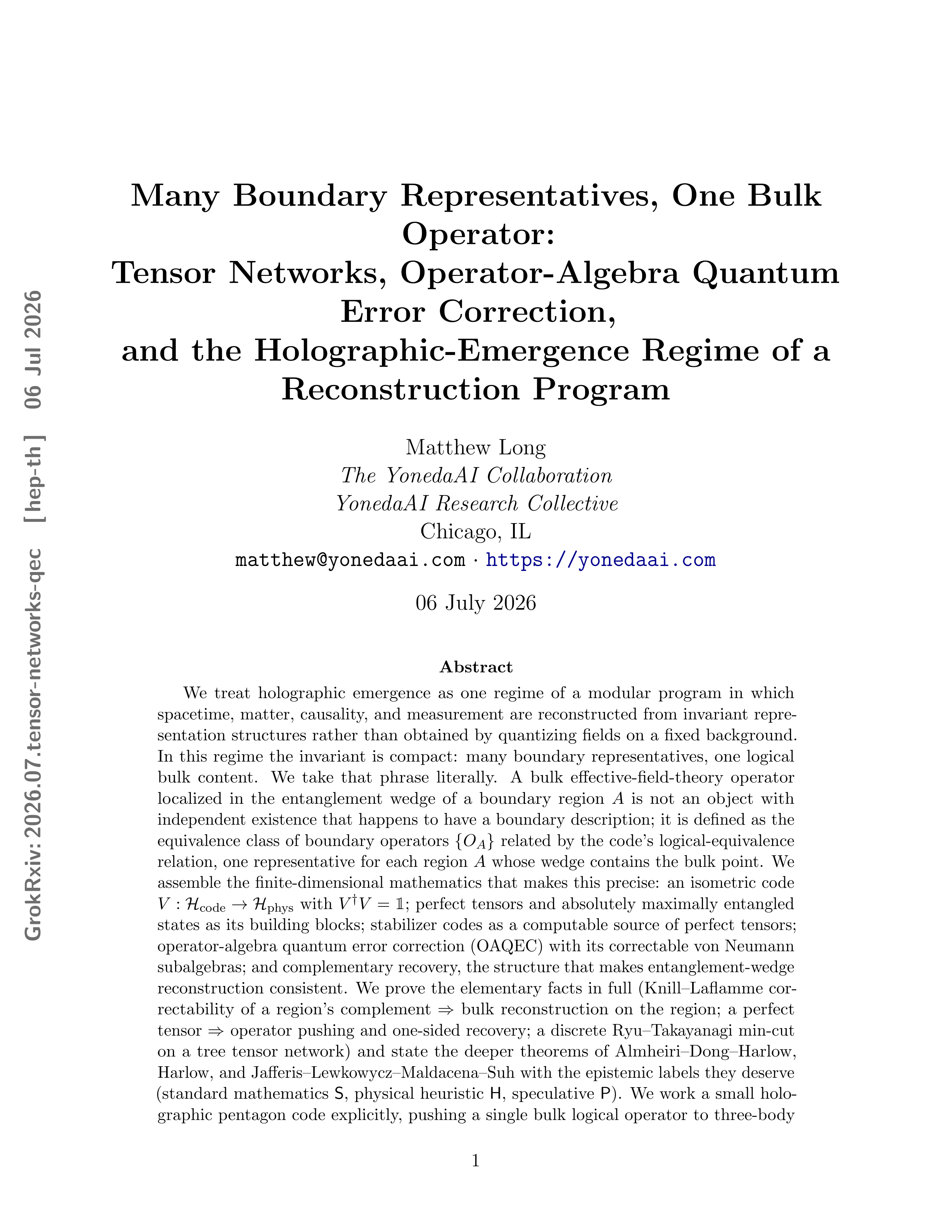
Cover illustration for Many Boundary Representatives, One Bulk Operator: Tensor Networks, Operator-Algebra Quantum Error Correction, and the Holographic-Emergence Regime of a Reconstruction Program
Part Vhep-th

Many Boundary Representatives, One Bulk Operator: Tensor Networks, Operator-Algebra Quantum Error Correction, and the Holographic-Emergence Regime of a Reconstruction Program

We treat holographic emergence as one regime of a modular program in which spacetime, matter, causality, and measurement are reconstructed from invariant representation structures rather than obtained by quantizing fields on a fixed background. In this regime the invariant is compact: many boundary representatives…

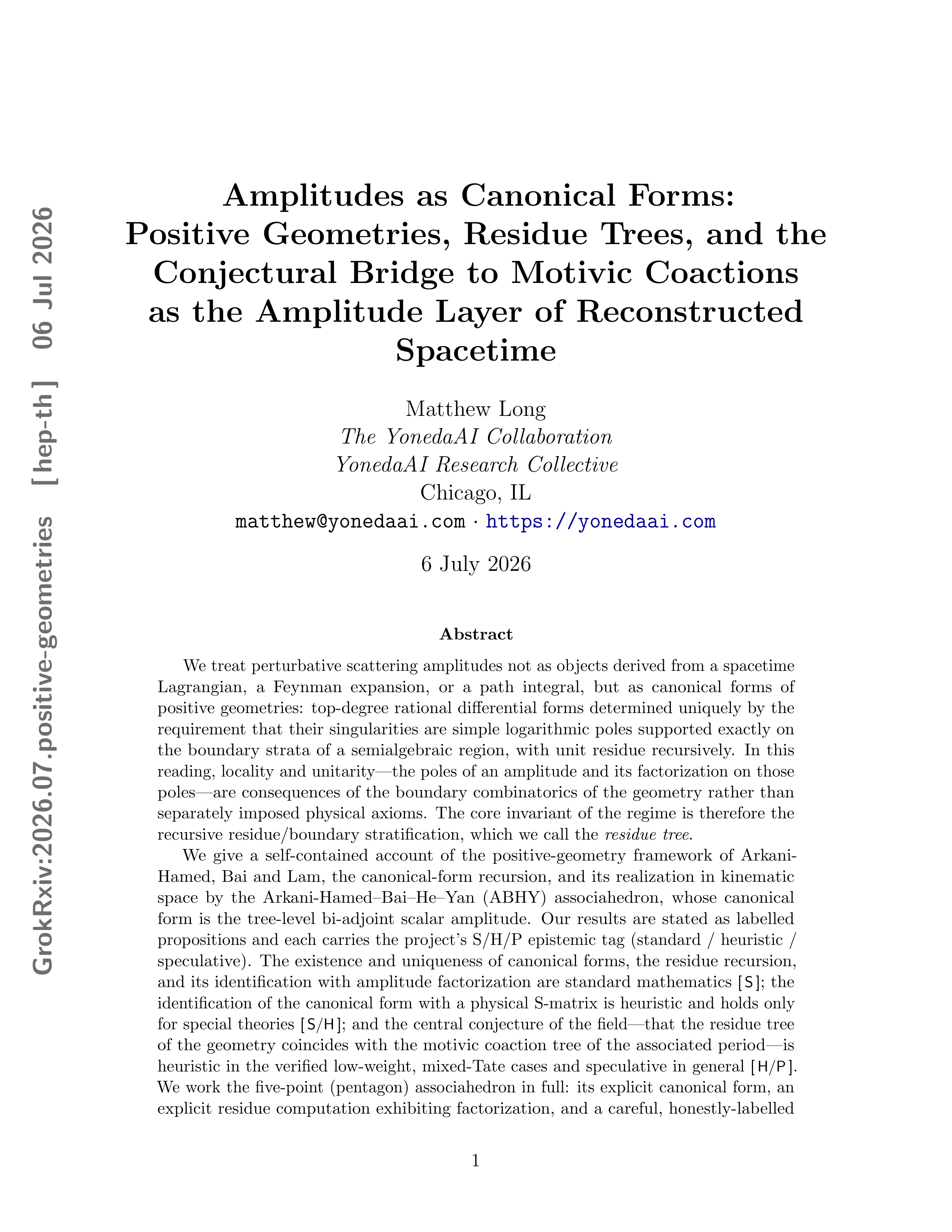
Cover illustration for Amplitudes as Canonical Forms: Positive Geometries, Residue Trees, and the Conjectural Bridge to Motivic Coactions as the Amplitude Layer of Reconstructed Spacetime
Part VIhep-th

Amplitudes as Canonical Forms: Positive Geometries, Residue Trees, and the Conjectural Bridge to Motivic Coactions as the Amplitude Layer of Reconstructed Spacetime

We treat perturbative scattering amplitudes not as objects derived from a spacetime Lagrangian, a Feynman expansion, or a path integral, but as canonical forms of positive geometries: top-degree rational differential forms determined uniquely by the requirement that their singularities are simple logarithmic poles…

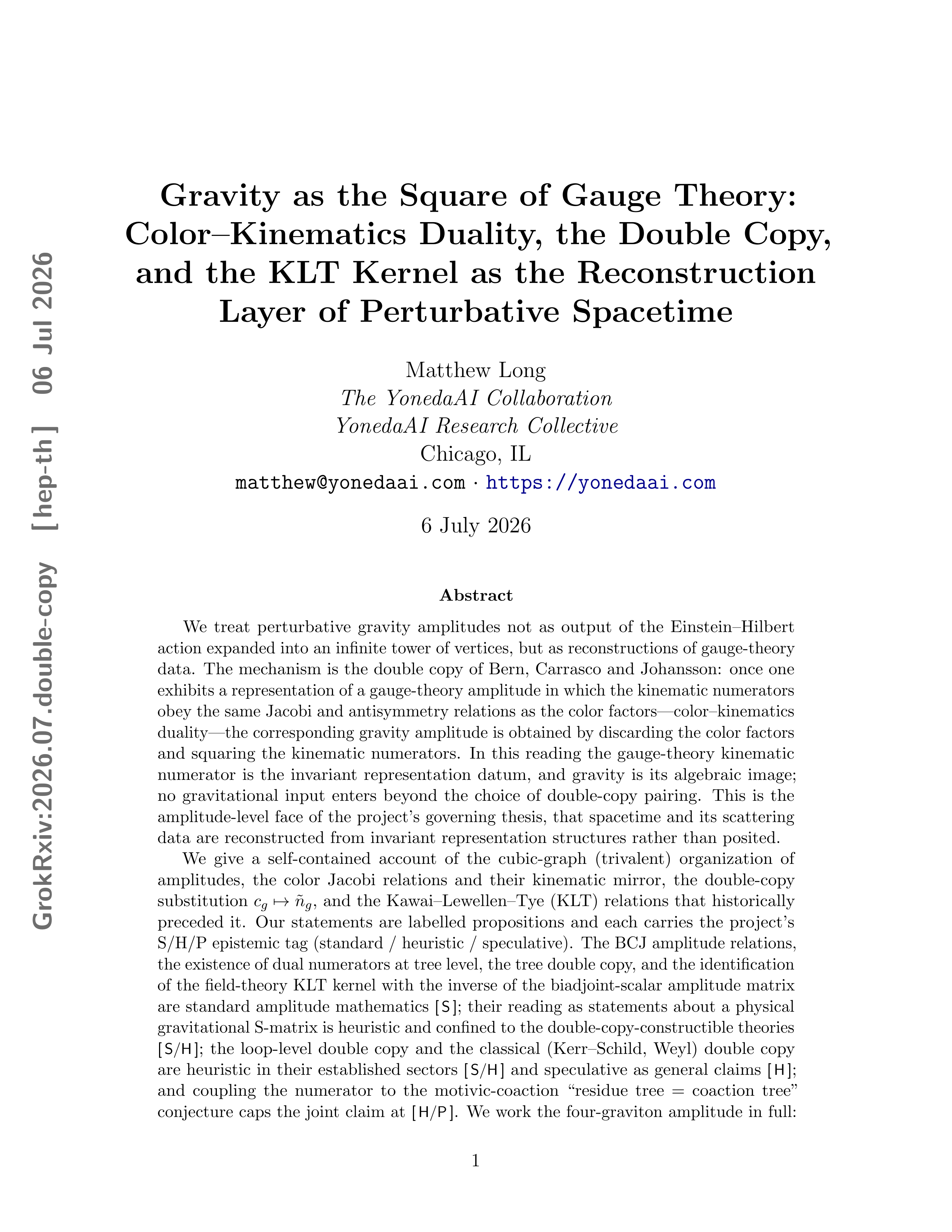
Cover illustration for Gravity as the Square of Gauge Theory: Color–Kinematics Duality, the Double Copy, and the KLT Kernel as the Reconstruction Layer of Perturbative Spacetime
Part VIIhep-th

Gravity as the Square of Gauge Theory: Color–Kinematics Duality, the Double Copy, and the KLT Kernel as the Reconstruction Layer of Perturbative Spacetime

We treat perturbative gravity amplitudes not as output of the Einstein–Hilbert action expanded into an infinite tower of vertices, but as reconstructions of gauge-theory data. The mechanism is the double copy of Bern, Carrasco and Johansson: once one exhibits a representation of a gauge-theory amplitude in which the…

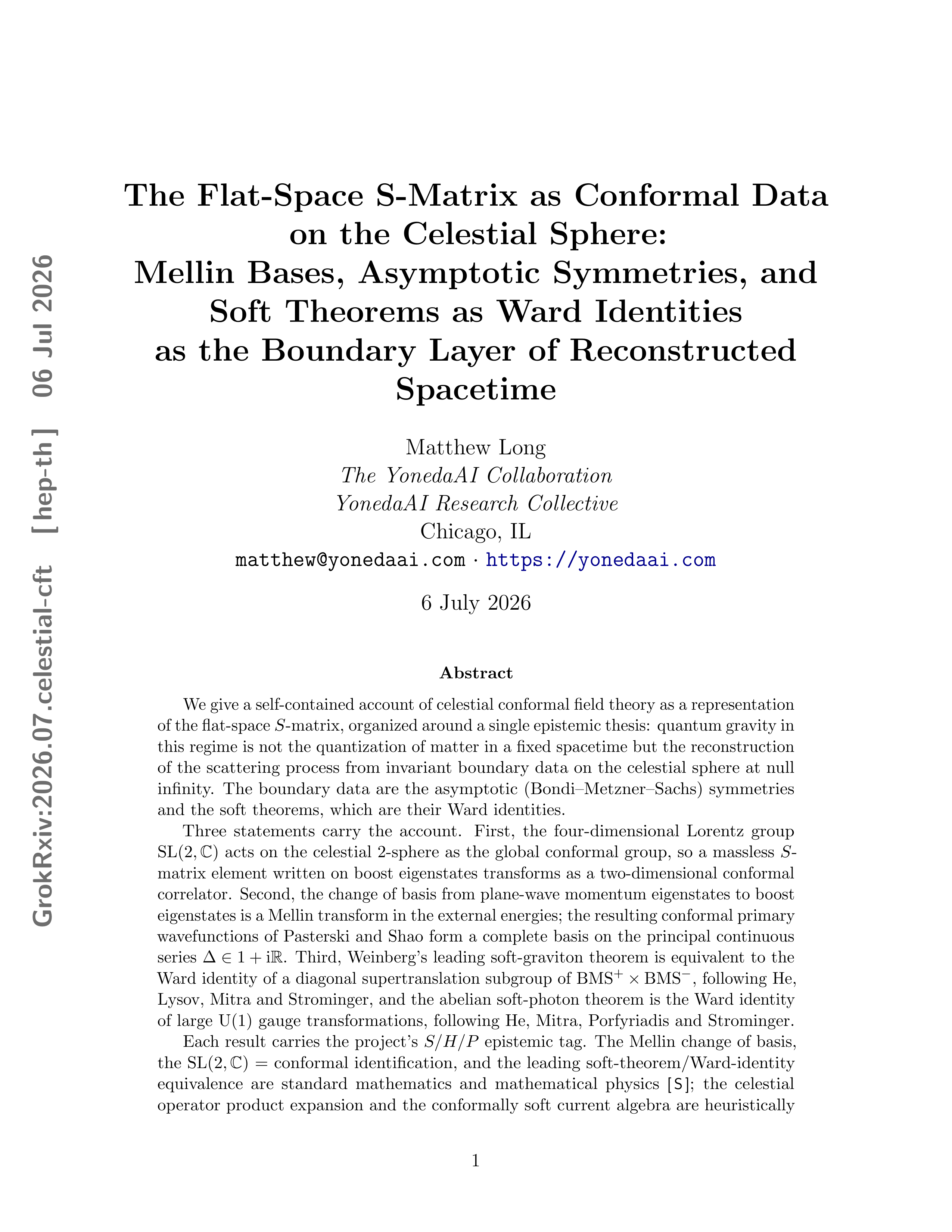
Cover illustration for The Flat-Space S-Matrix as Conformal Data on the Celestial Sphere: Mellin Bases, Asymptotic Symmetries, and Soft Theorems as Ward Identities as the Boundary Layer of Reconstructed Spacetime
Part VIIIhep-th

The Flat-Space S-Matrix as Conformal Data on the Celestial Sphere: Mellin Bases, Asymptotic Symmetries, and Soft Theorems as Ward Identities as the Boundary Layer of Reconstructed Spacetime

We give a self-contained account of celestial conformal field theory as a representation of the flat-space S-matrix, organized around a single epistemic thesis: quantum gravity in this regime is not the quantization of matter in a fixed spacetime but the reconstruction of the scattering process from invariant boundary…